Technique for Swimming: Smart Tips to Master Freestyle, Breathing & Speed
🏊♂️ Swim Smarter, Not Harder
Whether you’re a beginner looking to swim your first lap or an experienced swimmer trying to shave off precious seconds, mastering swimming technique is the ultimate game-changer.
Great technique for swimming isn’t about brute force — it’s about precision, control, breathing, and smart energy use.
In this guide, we’ll dive into the most effective techniques for swimming — from freestyle tips and breathing control to body alignment and the latest scientific insights that can instantly boost your speed and performance.
Mastering your technique for swimming is the foundation of becoming a confident, efficient swimmer — no matter your level or goal in the pool.
So, ready to stop wasting energy and start swimming like a pro? Let’s dive in.
🧠 Why Smart Swimming Matters?
Swimming isn’t just about strength — it’s about efficiency.
Developing the right technique for swimming gives you an edge — you swim longer, faster, and with less effort.
Every stroke you take, every breath you draw, and every turn you execute can either save energy or waste it. That’s why smart swimming technique matters more than ever — especially if you want to:
- Swim faster without getting exhausted
- Improve lap consistency and reduce drag
- Prevent shoulder injuries and burnout
- Adapt easily to longer distances or high-pressure races
⚠️ Fun fact: A study published in the Journal of Sports Science and Medicine (2025) showed that elite swimmers who used better block-start techniques — especially the long-step style — achieved significantly higher propulsion and faster takeoff speeds compared to those who used the short-step method.
This means: The smarter your technique, the greater your output — without needing more strength.
Whether you’re training for a competition or just aiming to glide smoothly through the water, mastering smart techniques can be the difference between a sluggish swim and a confident, efficient performance.
🏊♂️ Mastering Your Freestyle Technique
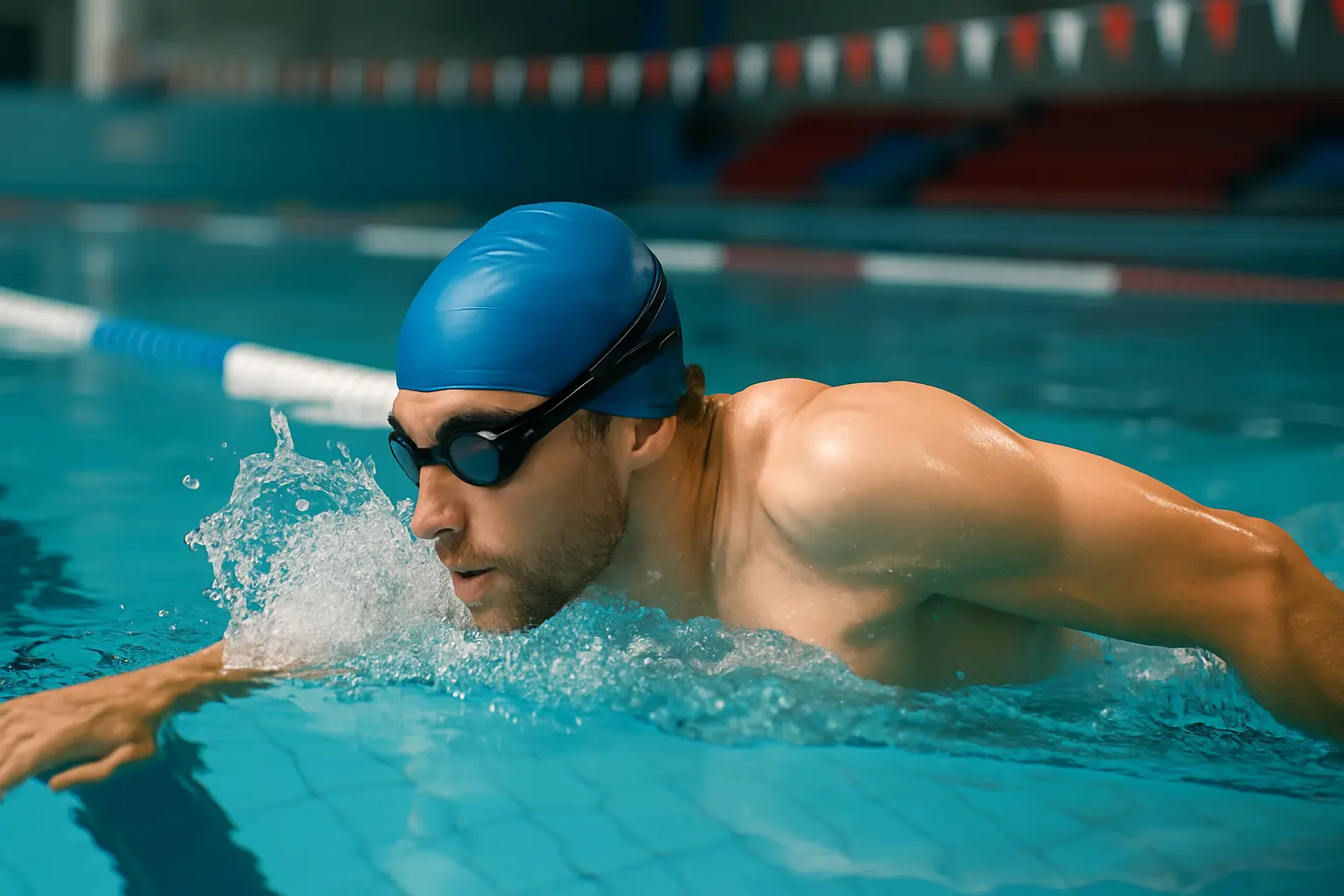
Freestyle (also called front crawl) is the fastest and most widely used swimming stroke — but also the most technically demanding when done right. Small improvements in form can dramatically reduce drag and increase efficiency. Let’s break it down.
1. Body Position: The Foundation of Speed
A proper freestyle starts with a horizontal and streamlined body position. Your goal is to minimize water resistance.
This simple adjustment is often overlooked, yet it’s one of the most underrated foundations of an effective technique for swimming.
✅ Tips:
- Keep your body flat and aligned with the surface.
- Engage your core — imagine pulling your belly button slightly in.
- Avoid excessive vertical movement (head bobbing or hips sinking).
🧠 Pro Insight: Think of your body as a boat: the more it stays on top of the water, the faster it moves.
2. Head Position: Small Angle, Big Impact
Many beginners look too far forward, which causes the hips to drop and increases drag.
✅ Best practice:
- Look slightly ahead (~45°), not straight forward or down.
- Your head should stay still; movement should come from the torso, not the neck.
🎯 Keep your head relaxed, and your body will follow.
3. Breathing Technique: Breathe Less, Swim More
Breathing can disrupt balance and rhythm. Mastering it is essential.
✅ How to improve breathing:
- Inhale quickly through the mouth during the turn (not when the mouth is fully above water).
- Exhale continuously through the nose while your face is in the water.
- Use bilateral breathing (alternating sides) for better symmetry and balance.
🫁 Don’t hold your breath — it causes tension and throws off your timing.
4. Arm Stroke Mechanics: Catch, Pull & Finish
Each stroke cycle has three phases that directly shape your overall technique for swimming:
- Catch: Fingers enter the water in front of the shoulder (not crossing midline).
- Pull: Bend your elbow and pull through the water, keeping forearm vertical.
- Finish: Push past the hip before recovery.
✅ Avoid Common Technique for Swimming Mistakes:
- Don’t overreach or slap the water.
- Don’t pull with a straight arm — it reduces power and control.
5. Recovery Phase: Relax and Reset
Recovery is the part of the stroke above water. This is your moment to stay relaxed while preparing for the next stroke.
✅ Tips for better recovery:
- Keep your elbow high.
- Hand should move close to the water, fingers relaxed.
- Avoid stiff, robotic arm movements.
🌀 Efficient freestyle is a blend of power underwater and fluidity above.
6. Kick Technique: From the Hips, Not the Knees
Freestyle kicking adds stability and propulsion — but only if done right.
✅ Correct kick form:
- Kick from your hips, not your knees.
- Small, fast flutter kicks are more efficient than big splashes.
- Keep your ankles loose and flexible.
🚀 Elite swimmers don’t overpower with their legs — they support the stroke rhythm and reduce drag.
7. Timing and Coordination: The Real Secret
Freestyle is all about timing — how your arms, legs, and breathing work together.
✅ Smart tips to improve timing:
- Don’t pause between strokes — aim for continuous, flowing motion.
- Breathe without breaking the stroke rhythm.
- Use a slight body roll to aid the reach and catch phase.
🧩 Think of your stroke as a chain of movements — not isolated actions.
✅ Quick Recap: Freestyle Must-Dos
- Maintain a streamlined, flat body.
- Master rhythmic breathing and arm mechanics.
- Kick smart, not hard.
- Train with purpose — film yourself if needed, or get feedback from a coach.
💡 Bonus Tip: Even Olympic swimmers return to basics often. Drills like catch-up, fingertip drag, and single-arm freestyle are fantastic tools to refine your technique.
🌬️ Optimizing Breathing for Endurance and Control
Mastering your breathing is one of the most underestimated technique for swimming. Yet, it’s a powerful tool for boosting endurance, control, and overall efficiency. Swimmers who struggle with stamina often have one thing in common: poor breathing technique.
Let’s explore how to breathe like a pro — without gasping for air every few strokes.
1. Understand the Purpose of Breathing in Swimming
Breathing isn’t just about survival — it’s about maintaining rhythm, reducing stress, and keeping your oxygen levels stable to avoid fatigue.
✅ Why it matters:
- Oxygen fuels your muscles and brain.
- Proper timing prevents stroke interruption.
- Balanced breathing supports symmetry and posture.
🧠 Swimmers who “hold their breath” tend to tense up, float poorly, and lose efficiency.
2. Bilateral Breathing: The Gold Standard
Bilateral breathing means alternating sides (e.g., breathing every 3 strokes). This technique helps with balance and body roll.
✅ Benefits of bilateral breathing:
- Improves stroke symmetry.
- Enhances balance and posture.
- Reduces overuse injuries on one side.
⚖️ Even if you favor one side, practicing both makes you a smarter, more adaptable swimmer.
This breathing method not only improves coordination but also refines your overall technique for swimming, especially during longer distances.
3. Exhale Underwater, Not Above
Many beginners make the mistake of holding their breath until their mouth is out of the water. This disrupts timing and forces rushed inhales.
✅ Pro breathing tip:
- Exhale gently and continuously through your nose while your face is in the water.
- Inhale quickly and deeply through your mouth during the turn.
- Don’t try to inhale and exhale at the same time — split the process.
🫁 Think of breathing like a cycle: out underwater, in above.
4. Head Position During Breathing
When you turn your head to breathe, your body must stay aligned. Poor head rotation = lost speed and added drag.
✅ Correct Technique for Swimming:
- Rotate the head with the shoulder roll, not independently.
- One eye should stay in the water; avoid lifting your head.
- Keep the opposite arm extended forward during the breath for balance.
🎯 Peek to the side, don’t look up.
5. Breathing Pattern Based on Goals
Your breathing strategy may vary depending on your workout:
| 🏁 Goal | 🔁 Recommended Pattern |
|---|---|
| Sprint (short distance) | Every 4–5 strokes or one side only |
| Endurance (long swim) | Every 2–3 strokes, alternating sides |
| Technique drills | Use bilateral breathing for balance |
Matching your breathing rhythm to your training goals is a subtle yet essential part of mastering your technique for swimming.
6. Dryland Breathing Drills
Yes — you can improve your breathing without getting wet!
✅ Dry drills to build breath control:
- Box breathing: Inhale 4 sec → Hold 4 → Exhale 4 → Hold 4
- Breath-hold walks: Walk while holding breath for 5–10 seconds
- Visualization: Practice turning the head with shoulder movement
These drills build lung capacity, mental calmness, and breathing discipline.
7. Fixing Common Breathing Mistakes
Let’s identify and fix the most frequent breathing problems:
| ❌ Mistake | ✅ Fix |
|---|---|
| Holding breath underwater | Exhale slowly through the nose |
| Gasping at the surface | Stay calm, keep breathing smooth and deliberate |
| Lifting head to breathe | Rotate head with body roll; don’t disrupt alignment |
| Always breathing on one side | Train both sides for balanced stroke |
| Inhaling water accidentally | Practice timing and keep one goggle in the water during breath |
✅ Quick Recap – Breathe Like a Pro:
- Exhale underwater, inhale quickly.
- Practice bilateral breathing.
- Sync head movement with body roll.
- Use dry drills to train lungs and rhythm.
💡 Pro Tip: In competitive freestyle, some swimmers breathe every 2 strokes to avoid fatigue buildup — others train breath control for longer intervals. The key is to find your balance between efficiency and oxygen needs.
🏊 Proven Drills to Improve Technique & Speed
No matter how experienced you are, drills are the foundation of mastery in swimming. They isolate key movements, break bad habits, and allow your muscles to memorize proper form. The best swimmers in the world still train with drills every session.
Here’s a list of battle-tested drills to upgrade your freestyle, breathing, body alignment, and speed.
Practicing these drills regularly helps refine your overall technique for swimming, building habits that last.
1. ✋ Catch-Up Drill
✅ Goal: Improve body alignment, hand entry, and stroke timing.
How it works:
- One arm stays extended forward while the other completes a full stroke.
- Hands “catch up” before starting the next pull.
Benefits:
- Reduces rushing the stroke.
- Promotes balanced body position and rhythm.
- Great for beginners and pros alike.
🧠 Use a snorkel during this drill to focus purely on form.
2. 💨 Fingertip Drag Drill
✅ Goal: Improve high-elbow recovery and muscle memory.
How it works:
- As you recover your arm over the water, drag your fingertips along the surface.
- Keep elbow high and relaxed.
Benefits:
- Encourages correct arm path.
- Promotes relaxed and efficient stroke recovery.
- Helps with shoulder flexibility.
🎯 Think “light and smooth” — not forced or fast.
3. 🫁 3-3-3 Breathing Drill
✅ Goal: Enhance breath control and symmetry.
How it works:
- Swim 3 strokes breathing to the right, then 3 to the left, then 3 with no breath.
- Repeat.
Benefits:
- Develops bilateral breathing.
- Trains rhythm and lung capacity.
- Boosts confidence during longer sets.
💡 Alternate with 5-5-5 for advanced breath training.
4. 🏹 Single Arm Drill
✅ Goal: Isolate and refine arm movement.
How it works:
- Swim using only one arm while the other stays at your side or extended forward.
- Alternate sides.
Benefits:
- Improves balance and core engagement.
- Sharpens hand entry and underwater pull.
- Great for spotting weaknesses in your stroke.
🔄 Try with a pull buoy to focus on upper-body technique.
💡 Pro Tip: To accelerate your progress, combine these coordination drills with feedback from a coach — it’s the fastest way to improve your technique for swimming on both sides.
5. 🌊 Kick on Side Drill
✅ Goal: Improve body rotation and streamline position.
How it works:
- Kick while lying on your side, bottom arm extended forward, top arm resting on your hip.
- Rotate slowly to switch sides.
Benefits:
- Strengthens kick and core.
- Teaches effective body roll.
- Builds awareness of hydrodynamic positioning.
📏 Keep one goggle underwater and one above — that’s the sweet spot!
6. ⚡ Speed Play (Fartlek) Drill
✅ Goal: Train speed bursts and recovery under fatigue.
How it works:
- Swim at easy pace for 1 lap, then sprint for ½ lap.
- Alternate throughout the set.
Benefits:
- Develops explosive speed.
- Trains your ability to recover mid-swim.
- Mimics real race pacing.
🕒 Mix in time intervals like 25m sprint / 50m cruise / repeat.
7. 📐 Sculling Drill
✅ Goal: Improve your “feel for the water.”
How it works:
- With arms extended forward, move hands side to side like waving — small motions only.
- Use different sculling positions (front, mid, hip).
Benefits:
- Builds awareness of water pressure.
- Teaches how to grip water better.
- Refines the catch phase of the stroke.
💬 Elite swimmers say this drill gives them “water sensitivity” — almost like sonar.
🛠️ How to Structure Drills in Your Practice
| 🔁 Frequency | ⏱️ Time per drill | 🔄 Integration Tip |
|---|---|---|
| 2–3 sessions/week | 10–20 minutes | Alternate drills with full-stroke laps |
| Warm-up or technique block | Best results | Add short rests to maintain good form |
| Film yourself | Optional but powerful | Visual feedback accelerates progress |
✅ Pro Coach Tip:
Log your drills and progress in a swimming journal. Note which drills felt smooth, which ones exposed weaknesses, and track time improvements after 2–3 weeks.
💡 Up Next: Let’s put all of this together by fine-tuning your alignment and body position. Shall we move on to Partie 6 – Perfecting Body Alignment and Streamlining ?
🧘♂️ Part 6 – Perfecting Body Alignment and Streamlining
If you’ve ever watched elite swimmers glide across the water with seemingly no resistance, you’ve witnessed the power of perfect body alignment. In swimming, technique isn’t just about speed — it’s about minimizing drag, and streamlining your body is key.
🌊 What Is Body Alignment in Swimming?
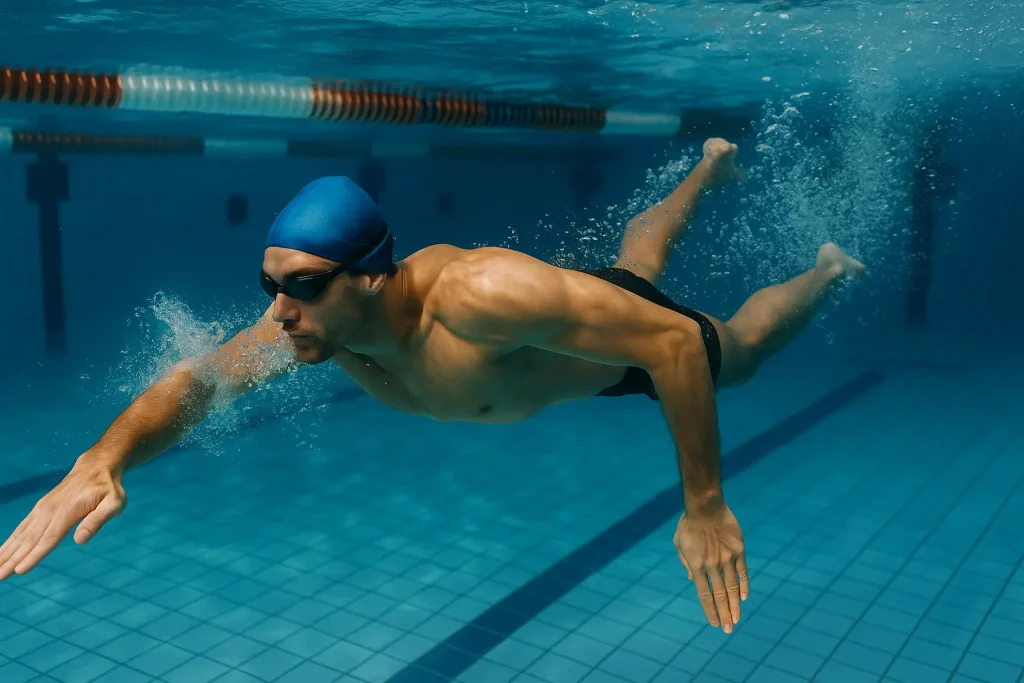
Body alignment refers to how your body is positioned in the water. When your head, spine, and hips are aligned horizontally, you reduce water resistance, maintain better balance, and conserve energy. This is especially important in freestyle, backstroke, and butterfly — strokes where hydrodynamics matter the most.
The best technique for swimming efficiently starts with awareness of how your body moves through the water.
🏄♂️ Streamline Position: Your Secret Weapon
The streamline is the most hydrodynamic position in swimming — arms extended above your head, biceps tight to your ears, hands stacked, and body straight as an arrow. It’s used after every push-off or dive.
Here’s how to execute a perfect streamline:
- Arms fully extended above your head
- Hands overlapping, one palm over the other, thumbs locked
- Head tucked between your biceps
- Core engaged, avoiding arching your back
Practicing streamlining drills after every turn improves muscle memory and speed.
🔍 Common Mistakes in Body Alignment
Even experienced swimmers sometimes fall into bad habits:
- Head too high – Lifting the head breaks the body line and creates drag.
- Hips too low – Causes resistance and slows momentum.
- Bent knees – Disrupt balance and streamline flow.
To correct this, ask a coach or training partner to film your stroke underwater. Visual feedback is one of the most powerful ways to refine your swimming technique.
💡 Drills to Improve Alignment & Streamline
- Push-Off Streamline Holds: After each wall push-off, hold the streamline as long as possible before starting your kick.
- Vertical Kick Drill: Forces you to keep your body straight in a vertical position while flutter kicking.
- Superman Drill: Float face-down, arms extended in streamline. Focus on body tension and maintaining alignment.
Include these in your warm-up or cooldown to reinforce good technique for swimming.
🏊♂️ Swimming Workouts: Build Endurance with Smart Practice
If you want your improved technique to actually pay off in the water, you need structured swimming workouts — not just random laps.
Smart swimming workouts help you:
- Reinforce proper technique under fatigue
- Improve your breathing rhythm and stroke efficiency
- Build endurance and speed in a progressive way
- Avoid overtraining and injuries
For beginners, focus on short interval sets like 4×25 meters with 30 seconds rest, technique drills, and breathing control exercises.
For advanced swimmers, include aerobic sets (e.g., 5×200 meters freestyle), mixed drills (like catch-up or fingertip drag), and sprint sets with a kickboard or pull buoy.
🔁 Repeat workouts consistently, track your time, and gradually reduce rest — that’s how real swimmers get faster, without wasting energy.
🏊 Bonus: Daily Habits to Improve Your Technique for Swimming
Improving your technique for swimming isn’t just about pool time — it’s also about what you do outside the water.
Add these small daily habits to your routine and you’ll notice huge gains over time:
- Record short videos of your swim to analyze your technique for swimming.
- Spend 5 minutes visualizing perfect strokes and streamlining.
- Practice shoulder mobility and breathing exercises daily.
- Re-read expert tips to refine your mental map of good technique for swimming.
These micro-habits build muscle memory, awareness, and consistent improvement — turning effort into lasting skill.
🏁 Conclusion: Swim Smarter, Not Just Harder
Improving your swimming technique isn’t just about shaving seconds off your time — it’s about transforming the way you move through the water. By focusing on precision, body position, and structured drills, you unlock a level of efficiency that raw effort alone can’t achieve.
Whether you’re an ambitious athlete, a fitness swimmer, or just someone who wants to feel confident and strong in the pool, mastering your technique is your fastest lane to progress.
And remember: in the water, small tweaks lead to big waves.
So next time you dive in, don’t just swim — swim smart.
❓ FAQ – Smart Swimming & Technique
How effective are 15-minute swimming workouts?
Surprisingly effective! Short, focused sessions like 15-minute workouts for swimmers can improve endurance, technique, and cardiovascular health — especially when they’re well structured. It’s all about intensity and intention, not duration.
Can beginners benefit from short swimming workouts?
Absolutely. Beginners can improve their technique and build confidence without getting exhausted. In fact, shorter sessions reduce the risk of fatigue-based errors and bad habits.
What are the best drills for quick swimming improvements?
Focus on technique-driven drills: catch-up freestyle, fingertip drag, sculling, and body-position glides. These drills improve form and efficiency — ideal for smart swimmers with limited time.
How often should I do 15-minute swim workouts?
3 to 5 times per week is ideal. With proper recovery and focus, short workouts can lead to steady improvements without overtraining.
Is it better to swim longer or smarter?
Swimming smarter is the foundation. Longer swims are great for endurance, but poor technique can turn them into counterproductive effort. Smart swimming balances technique, intensity, and duration for real progress.